


We develop experimental techniques enabling the analysis of nonlinear vibration behavior.

With our research in the field of contact mechanics we aim to make friction damping predictable.

Our methods for vibration simulation enable the design based on high-fidelity models.
How do we contribute to vibration-safe and durable aircraft engines?


The blades of aircraft engines and turbomachinery must survive resonances without damage. Furthermore, efficiency cannot be increased further without risking flutter (a self-excited vibration resulting from an unstable interaction with the gas flow). To ensure that the blades do not break during operation, damping must be known.

Damping is almost always caused by dry friction, for example in the blade-disk attachment or at the interlocked tip shrouds of neighboring blades. In fact, specifically designed friction dampers are installed. Without them, no engine would fly.
Our research enables the precise prediction of friction damping and the resulting vibrations. Together with our industry partners, such as MTU Aero Engines, we verify our simulation methods in engine tests, so that they are now used as standard in the development of new engines.
What exactly are we researching?
Even though contact interactions may seem ordinary, they probably are the greatest remaining challenge in structural dynamics. This is due to their highly non-linear and non-smooth nature (stick-slip; open-close), as well as the vast range of imiportant length scales. This requires fundamental research to develop completely new methods for numerical simulation and experimental dynamics.
Our main activites can be grouped into three fields:
- Contact mechanics: We develop measurement technology for the mechanical analysis of contacts with nanometer resolution, and we develop multiscale approaches to make friction damping predictable.
- Numerical simulation of vibrations: We develop numerical simulation methods that handle the non-smooth character of contacts robustly and efficiently and reduce the computational effort by several orders of magnitude compared to conventional finite element tools.
- Experimental analysis of vibrations: We develop methods for accurate experimental identification of damping, natural frequencies, and vibration modes as a function of the vibration level. State-of-the-art vibration measurement devices in combination with our control-based methods enable the investigation of complex dynamics that cannot be explained by linear theory.
The focus of our application-oriented research is on blades in turbomachinery. However, our methods are useful for a wide range of problems in aerospace engineering. For example, we also conduct research on flutter of aircraft wings, the dynamics of wind turbines, and thin-walled structures fastened by rivets or screws, such as external skin panels of aircraft.
Our network
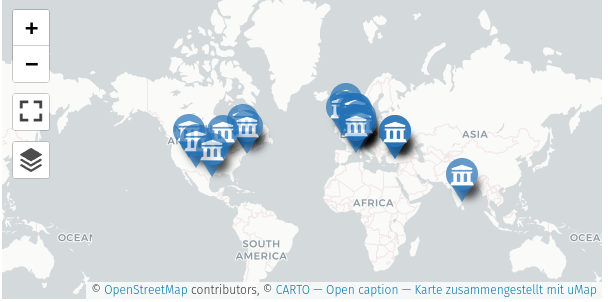
Our network spans distinguished national and international academic partners. We are also part of the university’s center of competence with MTU Aero Engines. Together with our partners, we actively promote the scientific development and mobility of outstanding and committed students. Past examples include Bachelor/Master theses with our partner institutions in Germany and abroad, participation in courses at the International Centre for Mechanical Sciences (CISM) , and participation in the Tribomechadynamics Research Camp.
Are you interested in joing our team?
Depending on the current stage of your academic education, you may apply for a position as a doctoral researcher, student assistant or for a Bachelor/Master thesis.
We also offer opportunities for postdoctoral researchers with appropriate scientific profile and track record. Due to the time lines of certain prestigious scholarships, we recommend to contact us about 1 year prior the start of your planned visit.

- Krack, M.; Gross, J.: Harmonic Balance for Nonlinear Vibration Problems , 159pp, (2019), Springer, ISBN: 978-3-030-14022-9.
- Krack, M. (2025). Systems with Contact Nonlinearities. In: Touzé, C., Frangi, A. (eds) Model Order Reduction for Design, Analysis and Control of Nonlinear Vibratory Systems. CISM International Centre for Mechanical Sciences, vol 614. Springer, Cham. https://doi.org/10.1007/978-3-031-67499-0_5
- Krack, M. (2024). Systems with Contact Nonlinearities . In: Gendelman, O.V., Vakakis, A.F. (eds) Exploiting the Use of Strong Nonlinearity in Dynamics and Acoustics. CISM International Centre for Mechanical Sciences, vol 613. Springer, Cham. https://doi.org/10.1007/978-3-031-56902-9_7
- Krack, M.; Panning-von Scheidt, L.: Nonlinear Modal Analysis and Modal Reduction of Jointed Structures . The Mechanics of Jointed Structures (2017), Springer, Matthew R.W. Brake (Ed.), ISBN: 978-3-319-56818-8
Contact

Malte Krack
Prof. Dr.-Ing.Head of Structural Mechanics / Dynamics Group